Skin Conditions

Skin problems are one of the most common reasons street animals in Bali need help. Learn to tell mange, demodex and fungal infections apart, and what to do about them.

Mange, scabies, demodex and fungal infections all cause itching, hair loss and scabs, but they are treated differently. This is general information only and does not replace a vet’s diagnosis. Find a clinic on our Recommended Vets page.

Skin conditions guide
WHY SKIN PROBLEMS ARE SO COMMON IN BALI
A rescued dog with severe hair loss and scaly, crusted skin
Severe hair loss, scaling and thick skin in a rescued Bali street dog. Photo: Mission Pawsible.

Skin disease is one of the most common reasons street dogs and cats in Bali need help. Heat and humidity keep skin damp, which suits yeast, fungi and bacteria. Fleas and ticks thrive all year. Many street animals are thin, stressed or sick, so their bodies struggle to keep mites and microbes under control, and crowded feeding spots let contagious conditions spread fast.

Many skin problems look alike: hair loss, scabs, redness and scratching. Guessing is risky, because the wrong treatment can make things worse. A vet can usually tell them apart with simple tests.
SARCOPTIC MANGE (SCABIES)
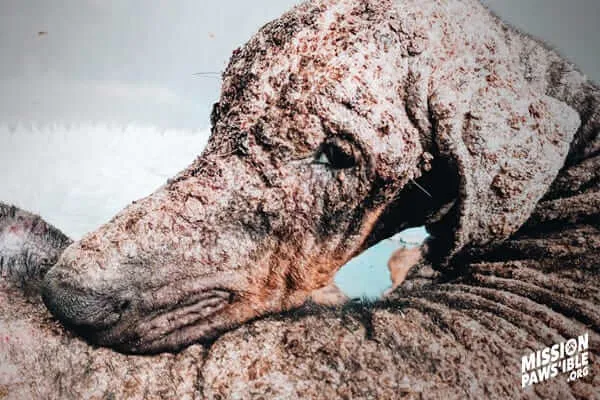
A rescued dog with thick crusts and hair loss on the head and body
Crusted skin and hair loss in a rescued street dog. Mange can look like this when it goes untreated. Photo: Mission Pawsible.
What it is
A skin infestation by the mite Sarcoptes scabiei. The mites burrow into the skin and cause intense itching. In cats, a similar mite (Notoedres cati) causes “face mange”, which is common in tropical areas.
What it looks like
  • Very intense itch
  • Red skin, small crusted bumps, scabs and hair loss, usually first on the ear edges, elbows, hocks (ankles), chest and belly
  • Untreated, it spreads over the whole body. Skin becomes thick and crusty, the animal loses weight and severe cases can be fatal
  • Cats (Notoedres): crusts and hair loss on the ears, face and neck
Is it contagious?
Yes, highly, to other dogs and cats through contact or shared bedding. People can get a temporary itchy rash from dog mites. The mites cannot complete their life cycle on humans, and it usually clears once the animal is treated and bedding cleaned. See a doctor if you are itchy.
How a vet diagnoses it
Skin scrapings from the ear edges, elbows and hocks, looked at under a microscope. Mites are often hard to find, so a negative scrape does not rule it out. Vets often start a trial treatment when the signs fit.
DEMODEX (DEMODECTIC MANGE)
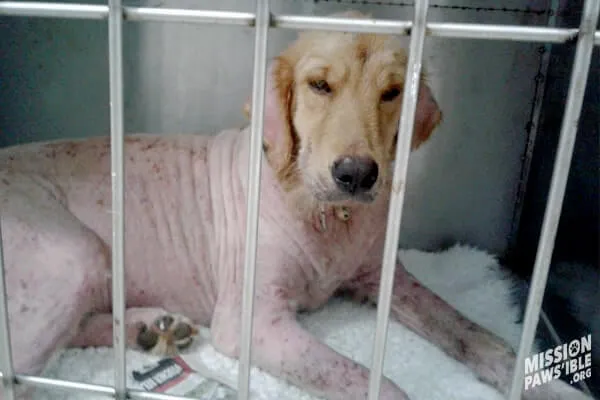
A rescued dog with bare pink skin and patchy hair loss
Bare, pink skin and patchy hair loss in a rescued dog. Many skin diseases look alike, so a vet must confirm the cause. Photo: Mission Pawsible.
What it is
Overgrowth of the Demodex mite. Small numbers live harmlessly in the hair follicles of healthy dogs. Disease happens when the immune system cannot keep them in check, because of age, genetics, illness, malnutrition or immune-suppressing drugs.
What it looks like
  • Usually mild or no itch, unless a bacterial infection has set in
  • Patchy hair loss with scaling, often around the eyes, lips and front legs. Puppies may have one to five small patches that often clear on their own
  • Widespread (generalised) demodex: hair loss over much of the body, redness, greasy skin, sores and a smell from secondary infection
  • An adult dog with demodex often has another illness underneath, which the vet needs to find
  • Cats can get demodex too, but it is less common
Is it contagious?
Dog demodex is not considered contagious. Puppies pick up mites from their mother in the first days of life. It does not spread to people. Some cat demodex (D. gatoi) can pass between cats, so ask your vet.
How a vet diagnoses it
Deep skin scrapes or hair plucks examined under a microscope. Mites are easy to find when the disease is active.
FUNGAL INFECTIONS
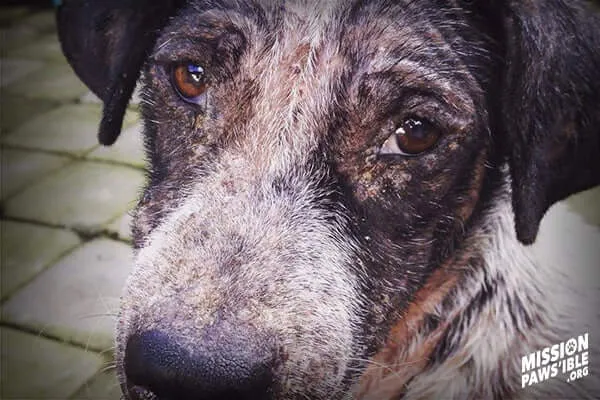
Close-up of a rescued dog with crusted skin and hair loss around the face
Crusting and hair loss around the face and muzzle of a rescued dog. Skin problems often overlap, so always get a diagnosis. Photo: Mission Pawsible.
Ringworm (dermatophytosis)

Not a worm. It is a fungus that infects hair and skin, most common in kittens, puppies and stressed or crowded animals.

  • Circular or irregular patches of hair loss, scaling and crusting. Itch varies from none to moderate
  • In cats it often shows on the face, ears and paws
  • Contagious to other pets and to people. In humans it causes red, ring-shaped scaly patches that are easy to treat. Spores can last in the environment for months
  • Diagnosis: a UV (Wood’s) lamp, hair examined under a microscope, a fungal culture (2 to 4 weeks or longer) and sometimes a PCR test
Malassezia yeast overgrowth

A yeast that lives normally on skin and ears but overgrows in warm, moist conditions, often alongside allergies or other skin disease.

  • Greasy, smelly (“musty”) skin, dark thickened skin, brown waxy ears and an intense itch, usually in skin folds, armpits, groin, ears and between toes
  • Not considered contagious in the usual sense
  • Diagnosis: cytology. The vet presses a slide or tape to the skin and examines it under a microscope

HOW ARE THEY DIFFERENT?

Animals often have two or three problems at once, and lookalikes are common.

Sarcoptic mangeDemodexRingwormMalassezia yeast
ItchSevere, constantMild or none, unless infectedVariable, often mildModerate to severe
Hair lossEar edges, elbows, hocks, belly, then spreadsPatchy on face and legs, or all overRound or irregular scaly patchesWith greasy, darkened skin
SmellNot usually, unless infectedOften, if infectedNot usuallyStrong, musty
Contagious to petsYes, highlyNot in dogsYesNo
Contagious to peopleTemporary itchy rashNoYesNo
Typical ageAnyPuppies, or older and ill dogsYoung, stressed, crowded animalsAny, often allergic dogs
Key testSkin scrape or trial treatmentDeep skin scrapeUV lamp, culture, microscopeCytology
HOW TO TREAT THEM

Always get a diagnosis first. Treatment differs for each condition, and some drugs are unsafe if the diagnosis is wrong. Do not use doses from the internet. Follow the product label for weight and age, and ask a vet. Items marked “Available from a reputable vet” need a vet’s diagnosis or prescription. Find one on our Recommended Vets page.

Sarcoptic mange
  • Oral tablets and chews from the isoxazoline family (such as Bravecto, NexGard, Simparica and Credelio) are widely used and effective. Available from a reputable vet
  • Selamectin spot-on is also commonly used, including for cats with face mange. Available from a reputable vet
  • Older options include ivermectin, milbemycin and lime-sulphur dips. Lime-sulphur is effective, but it stains, smells strongly and needs repeated dips.
  • Treat every animal in contact, even if they show no signs.
  • Wash bedding, collars and harnesses in hot water, or replace them.
  • Itch often eases within days. Full recovery takes several weeks.
Demodex
  • Mild patches in puppies can often be monitored without treatment.
  • Generalised cases need a vet. Treatment is usually an isoxazoline for at least two to three months, until vet-checked skin scrapes are negative. Relapse is common in the first year. Available from a reputable vet
  • Treat secondary infection, and find and treat any underlying illness.
  • Avoid steroids, which make demodex worse.
  • Dogs with early-onset generalised demodex should not be bred.
Fungal infections
  • Ringworm needs two parts: medication by mouth (such as itraconazole or terbinafine) Available from a reputable vet plus antifungal washes such as miconazole and chlorhexidine shampoo or lime-sulphur rinses.
  • Treatment usually takes 6 to 12 weeks, until a repeat culture is negative.
  • Isolate infected animals from other pets and children, and wear gloves.
  • Vacuum and wipe up hair, wash surfaces, use a fungus-killing disinfectant and wash bedding hot. Repeat weekly until cured.
  • Malassezia: antifungal and degreasing shampoo left on for 10 minutes, a few times a week, sometimes with oral antifungals Available from a reputable vet. Fix the underlying cause, such as allergy or fleas.
Lookalikes
  • Fleas and flea allergy: one flea bite can trigger intense itching, especially over the lower back and base of the tail. Treat with a vet-recommended flea product.
  • Bacterial skin infection (pyoderma): pimples, pus, crusts and hot spots. Needs a vet.
WARNINGS
Never use
  • Human steroid or itch creams. They can hide mange, worsen demodex and ringworm, and are harmful if licked.
  • Old motor oil, kerosene, petrol, diesel or detergents. They burn skin and poison animals.
  • Hydrogen peroxide, bleach, vinegar, undiluted tea tree oil or other essential oils on skin.
  • Human scabies products, or horse and cattle products, unless a vet says so.
  • Dog products on cats. Some dog flea, tick and mange products are toxic to cats.
Drug safety
  • Ivermectin and related drugs can be dangerous in collies, Australian shepherds, shelties and their crosses, and in any dog if the dose is wrong.
  • Isoxazolines have minimum age and weight limits on the label, and have been linked to tremors and seizures in some animals. Take care if the animal has ever had a seizure.
  • Pregnant, nursing, very young, underweight and sick animals need vet guidance.
  • Pick the weight band that matches your animal.
See a vet urgently if
  • The skin is raw, bleeding, swollen, or has pus or maggots
  • The animal is lethargic, not eating, feverish or losing weight fast
  • There is vomiting, tremors or seizures after any medicine
  • It is a young puppy or kitten with widespread skin disease
  • There is no improvement in a few days, or it is spreading
  • A person at home has a new itchy rash or ring-shaped patches. See a doctor and tell the vet
WHERE TO BUY MEDICINE IN BALI

Your vet will usually dispense the right product for the right weight, and that is the safest option.

Vet clinics and pet shops
  • Vet clinics: see our Recommended Vets page.
  • Pet shops: see our Recommended Pet Shops page.
  • Some products are also sold at apotek (pharmacies). Product availability varies, so call or message ahead to check stock.
  • Show the staff a clear photo of the product, including the brand, size and weight band. Check the expiry date and that the packaging is sealed.
Use GoShop to have it delivered

GoShop is a feature in the Gojek app where a driver buys items from a shop you choose and delivers them to you. It is handy for tourists, because you can get medicine from a clinic or pet shop without leaving a sick animal or hiring a scooter. Gojek lists Bali as a service area. Check that GoShop appears in your app.

  1. Open the Gojek app and choose GoShop.
  2. Search for the clinic or pet shop.
  3. Type the exact items you need.
  4. Check the pickup and delivery location, choose your payment method and confirm.
  5. Chat with the driver, and ask for a photo of the box before paying.

Limits: Gojek lists up to 13 items per order and delivery within 25 km. Foreign visitors may find GoPay needs Indonesian verification, so cash can be easiest.

Tips
  • Get a vet to confirm the diagnosis and product first.
  • Screenshot the product name, brand, form (chew, spot-on or tablet) and weight band, and check it is for dogs or for cats.
  • Call or WhatsApp the shop first to confirm stock.
  • Check the packaging and expiry date on delivery.
  • GoShop does not replace a vet visit.
PREVENTION
Keep skin healthy
  • Keep animals on regular flea and tick control. Many modern products also cover mites. Available from a reputable vet
  • Good food, vaccinations and regular deworming help the immune system.
  • Desex animals. It reduces roaming, fighting and spread.
  • Keep bedding clean and dry, and wash it weekly in hot water. Dry animals fully after bathing and swimming.
  • Keep new or rescued animals separate for at least two weeks. Check their skin closely.
  • Wash your hands after handling animals with skin problems.
  • Treat small problems early. Mild skin disease is easier to cure.
Sources
Merck Veterinary Manual: mange, ringworm and pyoderma. GoShop: Gojek Help.